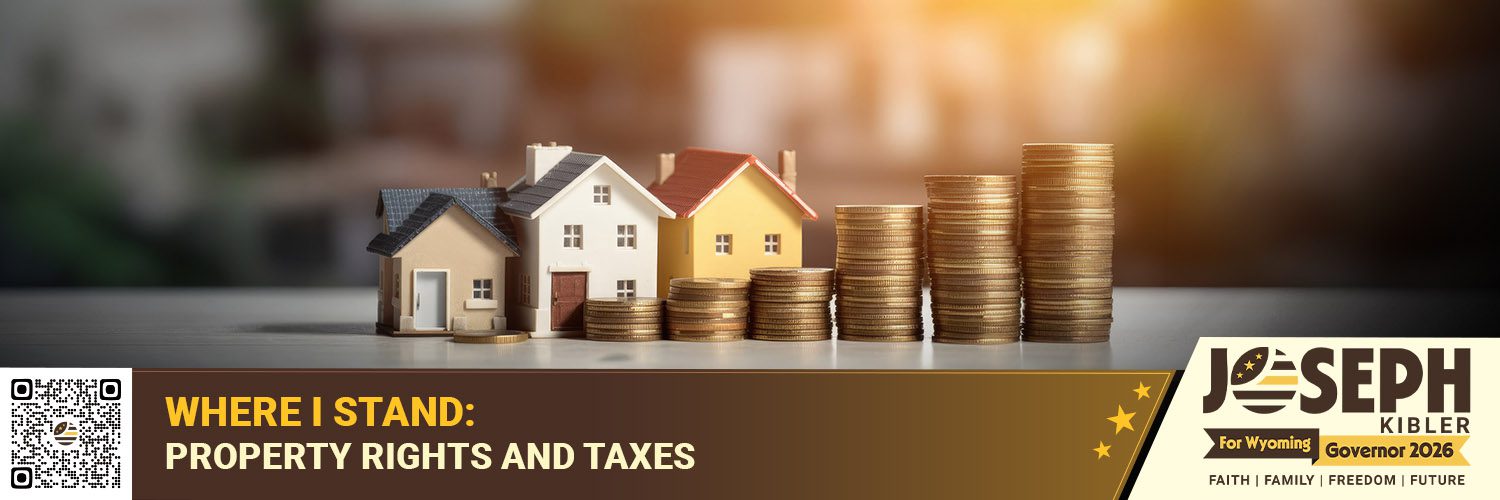
Property rights are one of the most basic freedoms we have. They’re not abstract. They’re about whether families truly own their homes, whether ranchers control their land, and whether communities get to shape their future — or whether those things are quietly dictated by rules, assessments, and bureaucracies far removed from everyday life in Wyoming.
Here’s where I stand — clearly and directly.
Property Rights Mean the Freedom to Build, Use, and Improve What You Own
At its core, property ownership should come with a simple promise: if you are privately funding something on your own land, you should have broad freedom to do it.
That means no subsidies, no special favors, no taxpayer-backed deals — just private individuals and families investing in their own property and their own future.
Freedom, however, also comes with responsibility.
There are limited, common-sense exceptions where additional review is appropriate — not to block progress, but to protect neighbors and communities.
Those exceptions should be narrow and clearly defined, including:
- Environmentally impactful medium and heavy commercial activities
- Uses that create clear, measurable harm to neighboring properties
- Projects that significantly affect shared resources or public safety
In those cases, local review involving neighbors and government makes sense. Not to control people — but to balance freedom with accountability.
What doesn’t make sense is blanket regulation, endless permitting, or treating every property owner like a potential problem before they’ve done anything wrong.
Property Rights Should Protect Families — Not Turn Homes Into Revenue Tools
For many Wyoming families, their home or land isn’t an investment vehicle. It’s their security. It’s where they raise kids, care for aging parents, and build something to pass on.
Yet today, property taxes increasingly function as a permanent rent paid to the government, regardless of whether a family’s income rises or falls.
When assessments climb faster than wages, people are taxed on value they haven’t realized and income they haven’t earned. That’s not fairness. That’s pressure.
Phase One: Roll Back to Assessed Values
The first step toward restoring sanity and fairness is straightforward:
Roll property taxes back to assessed values.
This immediately relieves pressure on families, seniors, and fixed-income residents who are being squeezed out of their homes by rising valuations they can’t control.
It’s a practical, responsible starting point — not a slogan.
Phase Two: A Real Plan to Eliminate Property Taxes
Rolling back assessments is not the end goal. It’s the beginning.
Property taxes, as currently structured, undermine true ownership. They allow government to place a perpetual claim on property that has already been purchased, already taxed, and already maintained by the owner.
That’s why phase two must be a detailed, comprehensive plan to eliminate property taxes altogether — without shifting the burden onto working families in other hidden ways.
That means:
- Honest accounting of what government truly needs to fund
- Eliminating waste, duplication, and institutional bloat
- Ending subsidies and sweetheart deals that drain public resources
- Building a system that respects ownership instead of penalizing it
This won’t happen overnight, and it shouldn’t be done recklessly. But it must be done intentionally, transparently, and with families at the center.
Freedom, Responsibility, and Local Control
Property rights work best when decisions are local, rules are limited, and people are trusted.
Wyoming doesn’t need more layers of permission. It needs clarity, restraint, and respect for the people who live here.
When families can confidently own, build, and improve their property without fear of being regulated or taxed out of it, communities thrive. That’s how we strengthen freedom — not just in theory, but in real life.
Why This Matters for Wyoming’s Future
Property rights and fair taxation aren’t side issues. They shape whether young families stay, whether seniors can age in place, and whether small towns survive.
If we want a Wyoming that remains independent, affordable, and rooted in responsibility, we must be willing to rethink systems that quietly erode ownership year after year.
That starts by putting people first.
And it continues by being willing to do something different.