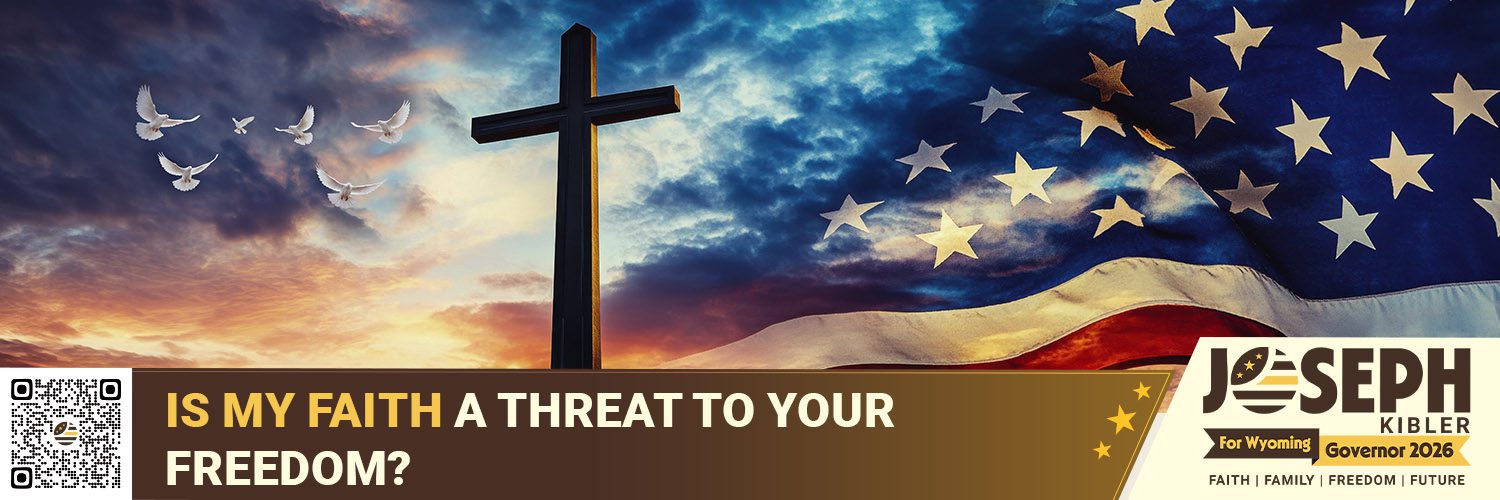
An honest answer to a fear most candidates won’t touch
As Wyoming approaches the 2026 governor’s race, there’s a concern I hear quietly but consistently. It’s rarely shouted and almost never framed as an accusation, but it’s real. Some people worry that when a leader speaks openly about faith—especially Christian faith—freedom itself may somehow be at risk.
That concern usually rests on an assumption: that conviction leads to control, that belief leads to coercion, and that faith expressed publicly must come at someone else’s expense. I don’t dismiss that fear, and I don’t exploit it politically. I think it deserves an honest answer.
Before addressing it directly, I want to say something clearly upfront. I don’t claim perfection, moral authority, or spiritual superiority over anyone else. Scripture itself warns against pretending we’re something we’re not. Micah 6:8 reminds us that what God requires is humility—to act justly, to love mercy, and to walk humbly with your God. Faith, when it is genuine, begins with humility, not power.
Faith and Hypocrisy: Naming the Problem Honestly
If we’re going to talk about faith in public life, we have to deal honestly with hypocrisy. It exists. Power has been abused under religious banners before. Pretending otherwise doesn’t protect faith—it undermines it.
The Bible is clear that faith without love is empty. In 1 Corinthians 13, Paul explains that belief, sacrifice, and even great conviction amount to nothing if they are not rooted in love. Faith that loses love becomes noise, not truth.
Scripture also reminds us who God is meant to reflect through us. Psalm 103:8 describes the Lord as merciful, gracious, slow to anger, and abounding in mercy. When faith is stripped of mercy and restraint, something has gone wrong.
So let me be very clear here:
- Faith used to dominate others is not faith done right
- Conviction without humility becomes hypocrisy
- Authority without love turns belief into a weapon
If someone uses faith to control others, they have missed the point entirely.
What My Faith Actually Requires of Me
My faith doesn’t tell me I’m better than anyone else. It tells me I’m accountable.
Romans 14:10 reminds us that we will all stand before the judgment seat of God. That truth applies to leaders as much as anyone else. Faith does not excuse behavior; it demands responsibility.
For me, that accountability shows up in very real ways. It shapes how I treat people who disagree with me, how I use influence and authority, and how I respond when I’m wrong.
Specifically, my faith requires that I take responsibility for:
- How I speak to and about people who don’t share my views
- How carefully I handle power and influence
- How willing I am to admit mistakes and correct course
Faith doesn’t remove accountability. It increases it.
Faith and Control Are Not the Same Thing
One of the most important distinctions we can make is between faith and control. Faith is rooted in choice; control is rooted in compulsion.
The Bible never commands forced belief. In fact, it explicitly affirms free choice. Joshua 24:15 says, “Choose this day whom you will serve.” Faith that is compelled is not faith at all—it’s compliance.
That difference matters, especially in public life:
- Faith says, “I choose”
- Control says, “You must”
That’s why freedom of conscience matters so deeply to me—not just for people who share my beliefs, but for everyone in Wyoming. Your freedom does not depend on agreeing with me. Your rights do not come from sharing my convictions.
Why Faith Makes Me Careful With Government Power
This part surprises some people. My faith does not make me want bigger government. It makes me cautious of it.
Scripture repeatedly warns against placing ultimate trust in human authority. Psalm 146:3 cautions us not to put our trust in princes or human power. Government has a role, but it is not God, and it should never be treated as such.
Faith reminds us of something essential: every human is fallible. That reality demands restraint, limits, and humility when power is involved.
That’s why my instinct is not to expand control, but to limit it:
- Limit the reach of government into conscience
- Limit the concentration of power
- Limit the assumption that authority always knows best
Wyoming Values Over Political Labels
Wyoming has lived this balance well for generations. People here understand that freedom works best when it’s paired with responsibility and mutual respect.
You live your life.
I live mine.
We respect each other.
And when it matters, we help.
That way of life isn’t theocracy, and it isn’t authoritarianism. It reflects a simple biblical principle found in Romans 12:18: as much as it depends on you, live peaceably with all. Matthew 5:9 reminds us that peacemakers—not power-seekers—are blessed.
Freedom rooted in responsibility works, and Wyoming proves it every day.
Why This Matters in the 2026 Wyoming Governor’s Race
This election is not about imposing belief or pushing faith out of public life. It’s about whether leadership understands humility, restraint, and the limits of power.
Faith, when lived honestly, does not threaten freedom. It protects it by reminding leaders that they are not the final authority and that coercion is never virtue.
You don’t have to choose between faith and freedom. You never did.
Why I’m Running
I’m not running to impose belief, and I’m not running because I think I’m better than anyone else. I’m running because I believe freedom survives best when:
- Power is restrained
- Conscience is protected
- Leaders are accountable
- People are trusted
My faith doesn’t make me dangerous to your freedom.
It makes me careful with power.
And that is exactly the kind of leadership Wyoming deserves.